

Liquid Alkaline Electrolyzer with Concentrated Electrolyte Transport
Description
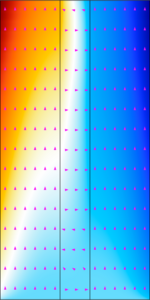
This tutorial demonstrates how to modify a concentration-independent (also known as a secondary current distribution) liquid alkaline water electrolyzer with concentrated electrolyte theory to explicitly resolve local electrolyte and solvent concentrations (thereby creating a tertiary current distribution). A liquid alkaline electrolyzer is defined in a 2D model with a separator, two gas-electrolyte compartments, and negative hydrogen and positive oxygen electrodes at the boundaries. A stationary solver is used with the cell voltage swept over a range of potentials to generate a polarization curve.
The model is first solved for a secondary current distribution only. Concentrated electrolyte theory is then added and the cell performance is compared between the secondary and tertiary current distribution cases.
Pre-requisites
- aec_concentrated_electrolyte.mph - 10.12MB
- aec_concentrated_electrolyte_inlet_velocity.txt - 0MB
- aec_concentrated_electrolyte_parameters.txt - 0MB
- aec_concentrated_electrolyte_variables_electrode.txt - 0MB
- aec_concentrated_electrolyte_variables_koh.txt - 0MB
- models.fce.aec_concentrated_electrolyte.pdf - 0.87MB
Apply for this Project
Please login to apply for this project and access full features.
Login to Apply